Most people spend a lot of time thinking about dining room walls, flooring, and furniture — and almost no time looking up. That’s a missed opportunity. The ceiling is one of the most underused design surfaces in the home, and in a dining room, it has a direct impact on how the space feels: formal or casual, intimate or expansive, plain or polished.

The good news is that a great dining room ceiling design doesn’t require a major renovation or a big budget.
In this guide, you’ll find 20 specific ceiling ideas — from simple paint techniques to structural details — along with practical advice on what works, what to avoid, and how to match the ceiling to the rest of your room. Whether you’re dealing with low ceilings, a tight budget, or a style that’s hard to define, there’s a workable idea here for you.
1. Coffered Ceiling for Classic Structure
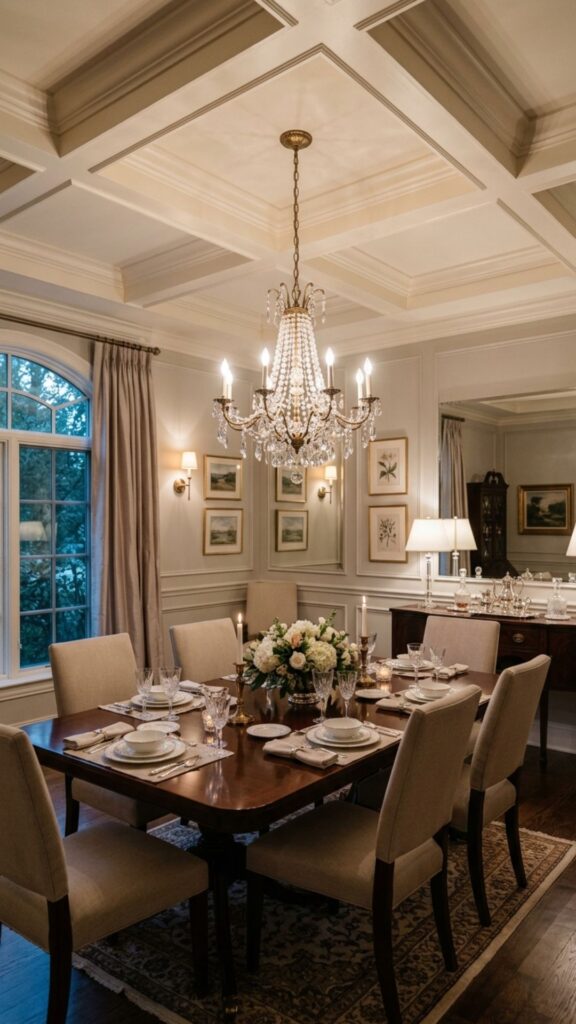
A coffered ceiling features a grid of recessed panels framed by beams, and it’s one of the most timeless dining room ceiling designs available. It adds architectural weight and formality to the room without requiring you to change anything below — it works above almost any furniture style.
For an existing flat ceiling, lightweight polyurethane coffer kits are a cost-effective alternative to real wood or plaster. They install with adhesive and nails and paint to look nearly identical to built-in millwork. Keep the coffer color within one shade of the ceiling to avoid the grid looking too heavy.
2. Shiplap Ceiling for Relaxed Character
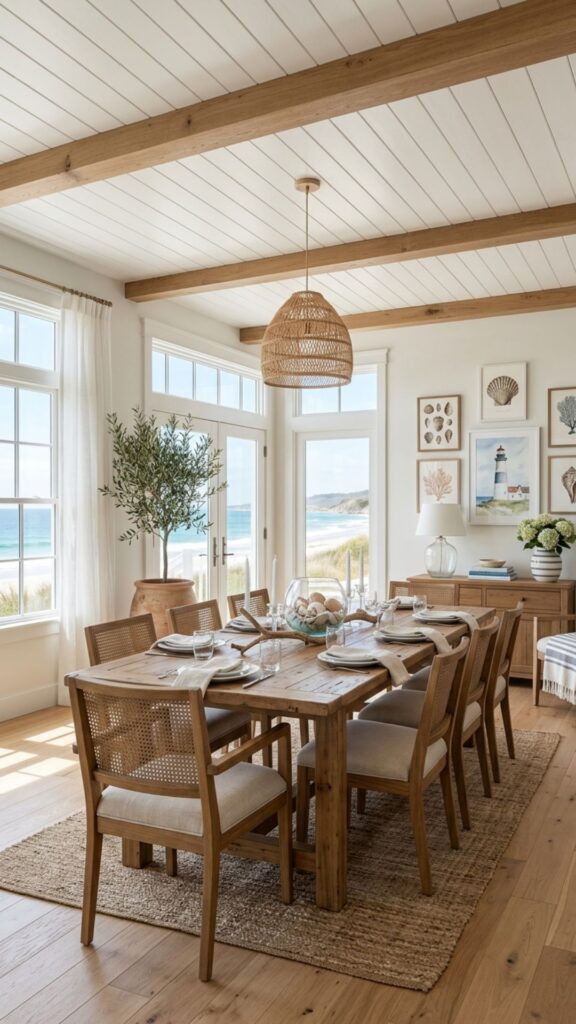
Horizontal shiplap boards installed across the ceiling add warmth and texture in a way that feels casual and approachable. It works especially well in farmhouse, coastal, or transitional dining rooms where a formal ceiling treatment would feel out of place.
Paint the shiplap the same white or off-white as your walls and trim for a seamless, airy effect. If you want more contrast, go one shade warmer or deeper than the walls — this creates definition without making the ceiling feel heavy. Shiplap also works on vaulted ceilings where the angle adds visual interest on its own.
3. Painted Ceiling in a Deep Accent Color
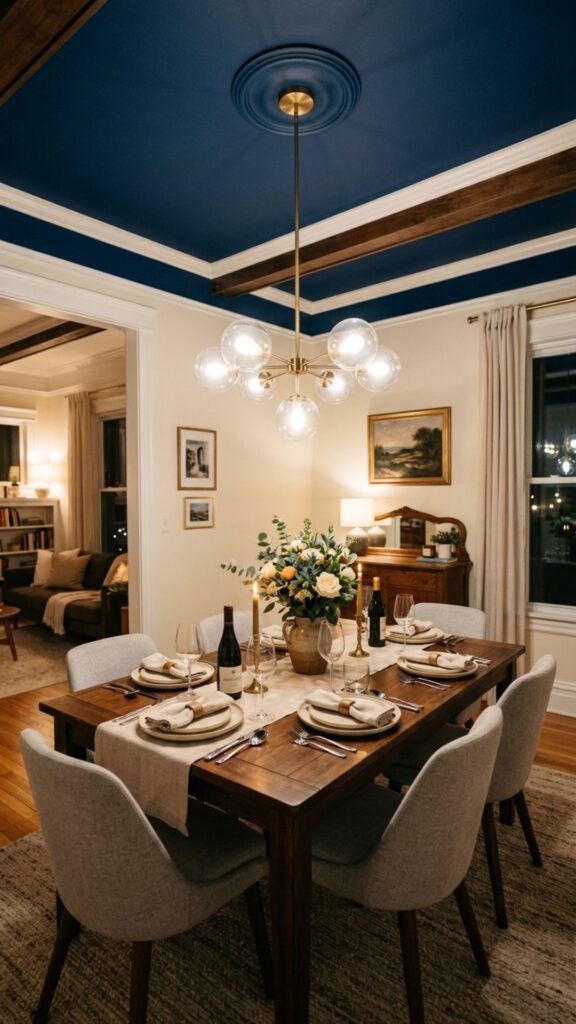
One of the simplest and most effective dining room ceiling design moves is painting the ceiling a bold, saturated color. Navy, forest green, burgundy, and charcoal all work beautifully above a dining table — they create a sense of enclosure that makes the room feel intentional and cozy.
The trick is to bring the ceiling color down two or three inches onto the wall. This “eyelid” technique softens the hard line where the ceiling meets the wall and makes the color choice look deliberate rather than accidental. Pair a dark ceiling with lighter walls and plenty of warm lighting to balance the depth.
4. Tray Ceiling with Accent Lighting
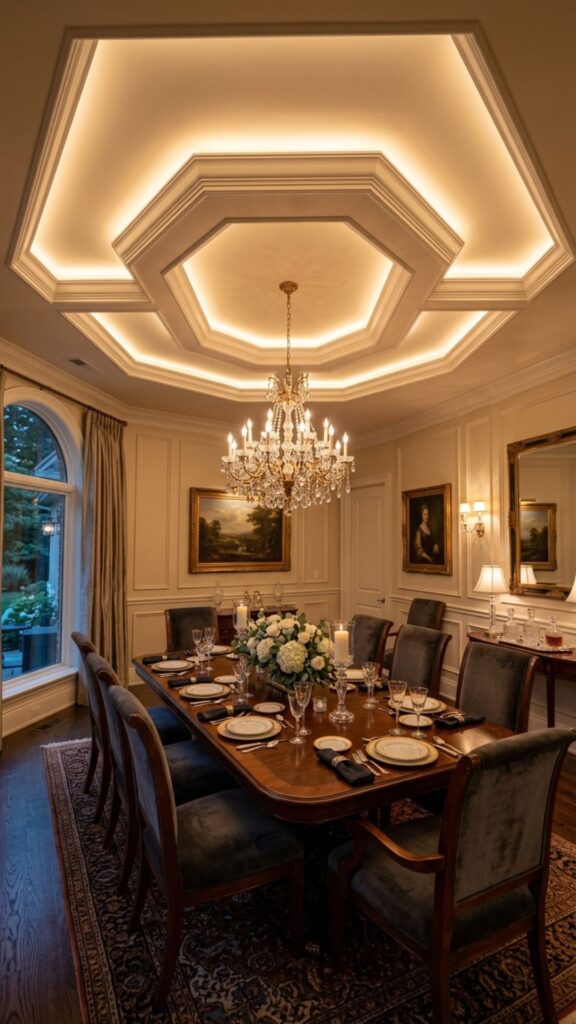
A tray ceiling — where the center section is recessed higher than the surrounding border — adds dimension and creates a natural focal point directly above the dining table. It’s one of the more popular dining room ceiling designs in new construction, but it can also be added to an existing flat ceiling with framing and drywall work.
The recessed center is an ideal spot for LED strip lighting, which casts a soft upward glow around the perimeter. Use a warm white (2700K to 3000K) for a flattering, dinner-friendly light quality. For added drama, paint the inner ceiling of the tray in a contrasting color or apply metallic wallpaper inside the recess.
5. Exposed Wooden Beams
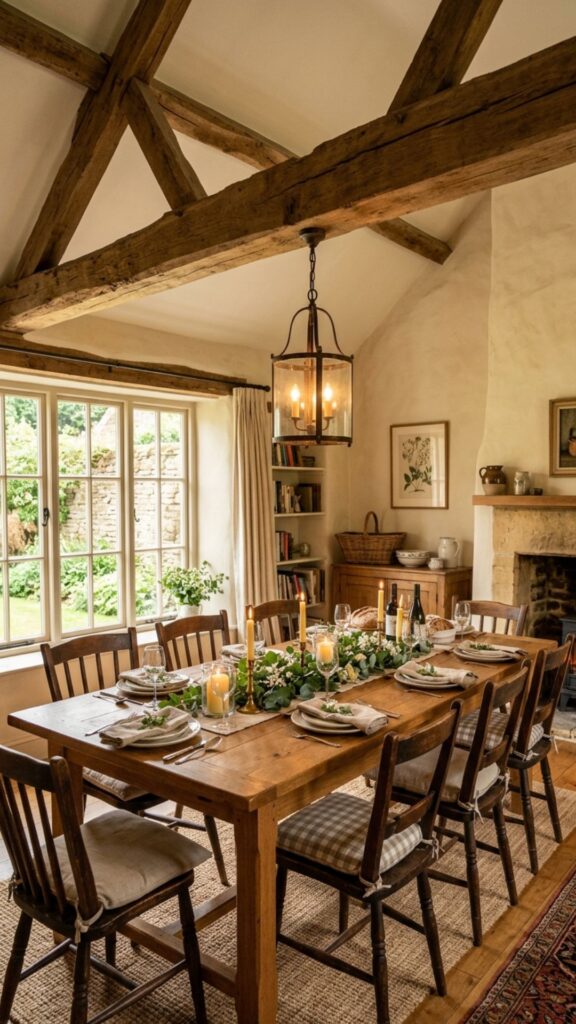
Exposed ceiling beams — whether structural or decorative — add texture, warmth, and a sense of age that’s hard to replicate any other way. In dining rooms, a pair or trio of beams running perpendicular to the table’s length draws the eye along the room and creates a natural architectural frame.
Faux wood beams made from lightweight polyurethane foam look surprisingly convincing and cost a fraction of real timber. They install in hours rather than days and come in a wide range of stained and painted finishes. Space them evenly and align them with lighting or pendant placement for a cohesive result.
6. Wallpapered Ceiling
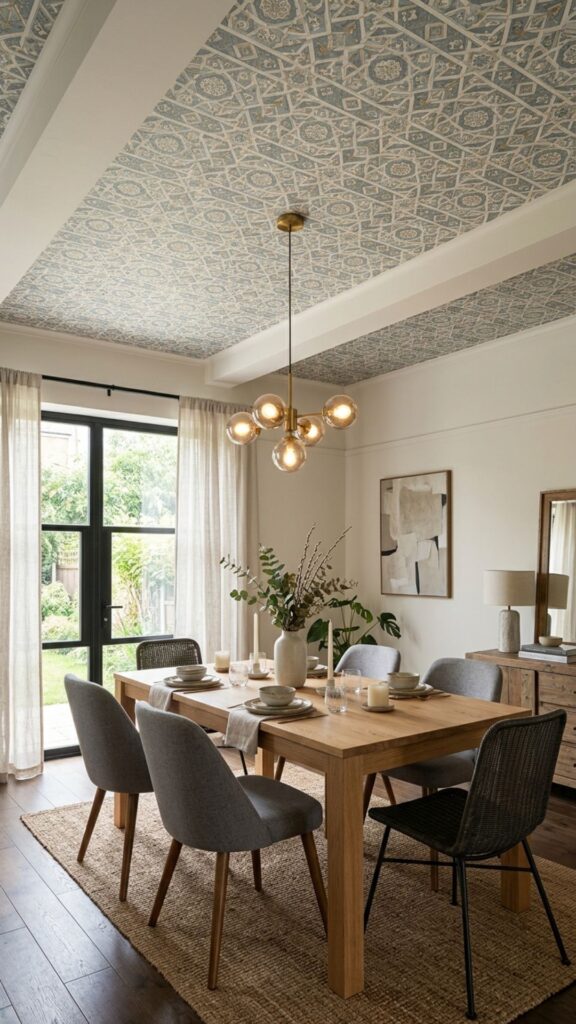
Wallpaper isn’t just for walls. Applied to the ceiling, a bold or patterned wallpaper becomes the unexpected focal point of the dining room — one that draws the eye upward and makes the space feel curated and deliberate.
Choose a pattern with moderate scale: too small and it reads as noise from below; too large and it can feel overwhelming. Botanical prints, geometric patterns, and soft watercolor designs all work well on dining room ceilings. If you’re nervous about committing to the whole ceiling, apply wallpaper only inside a tray or coffered recess to contain the pattern.
7. Medallion with Statement Chandelier
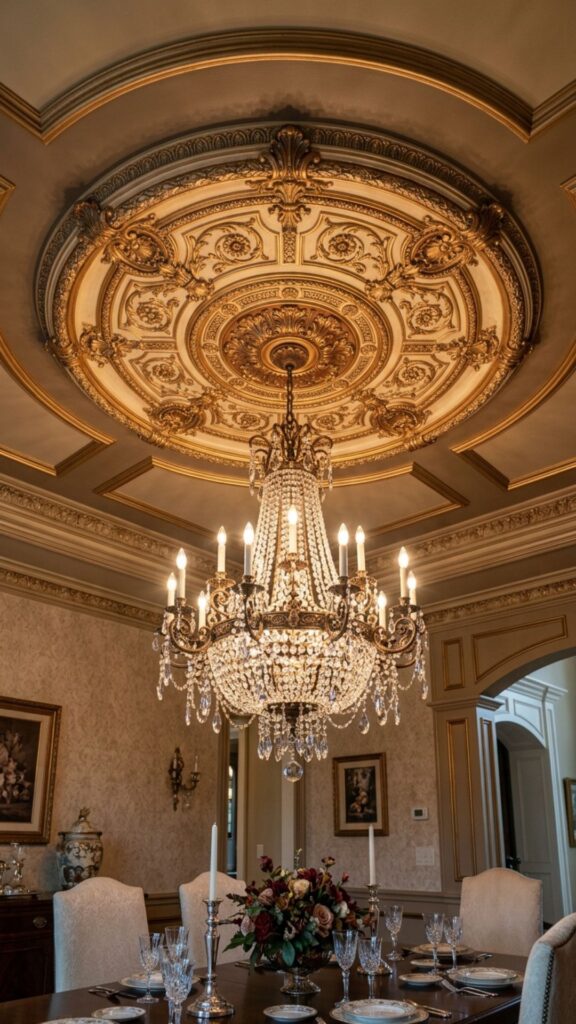
A ceiling medallion — a decorative circular molding installed around a light fixture — is one of the easiest ways to elevate a plain ceiling and make a chandelier look purposefully placed. It costs very little but has a significant visual impact.
Medallions come in plaster, polyurethane, and PVC and range from 12 to 36 inches in diameter. Choose a size proportional to your chandelier: the medallion should be about the same width as the fixture’s base or canopy, or slightly larger. Paint it the same color as the ceiling for a subtle effect, or use a contrasting white or cream to make it stand out.
8. Tongue-and-Groove Planks
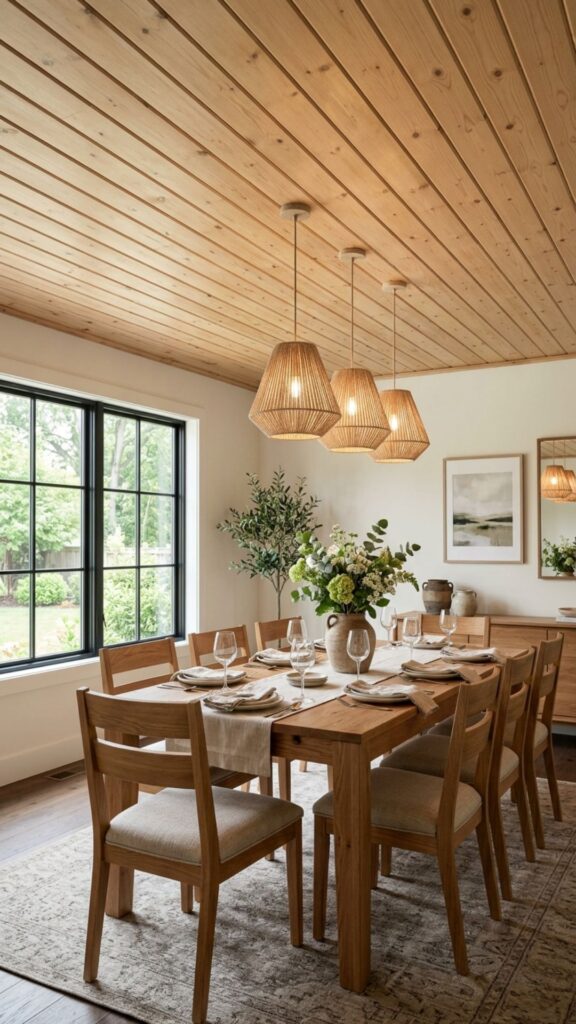
Tongue-and-groove wood planks installed horizontally across the ceiling create a finished, intentional look that reads as both rustic and refined depending on the finish you choose. Stained dark, they anchor the room; painted white, they keep the space light and airy.
This ceiling treatment works particularly well in dining rooms with cathedral or vaulted ceilings, where the angle emphasizes the linear pattern of the planks. For a flat ceiling, use planks no wider than four inches — wider boards on a flat surface can start to feel oppressive in a dining room context.
9. Black Ceiling for Bold Drama
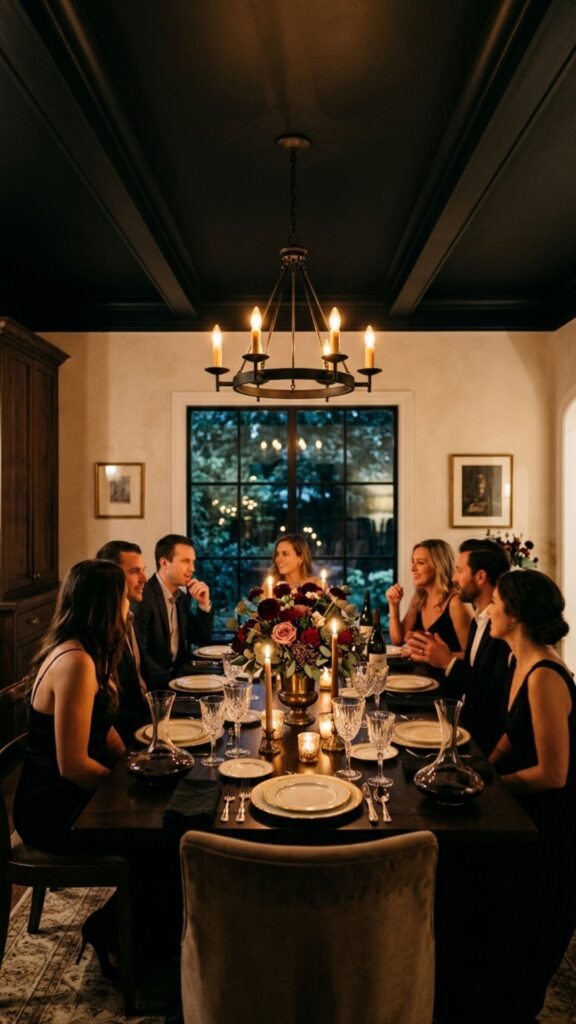
A fully black ceiling is a confident dining room ceiling design choice — and one that works better than most people expect. Black creates an intimate, cocooning effect that’s particularly flattering in the evening light most dining rooms rely on.
It’s most effective in rooms with natural light during the day, since the darkness at night feels intentional rather than gloomy when there’s contrast with daytime brightness. Keep the walls light — white, warm cream, or soft grey — and lean into warm lighting to balance the ceiling’s intensity. Black works equally well in matte or satin finishes.
10. Whitewashed Beam Ceiling
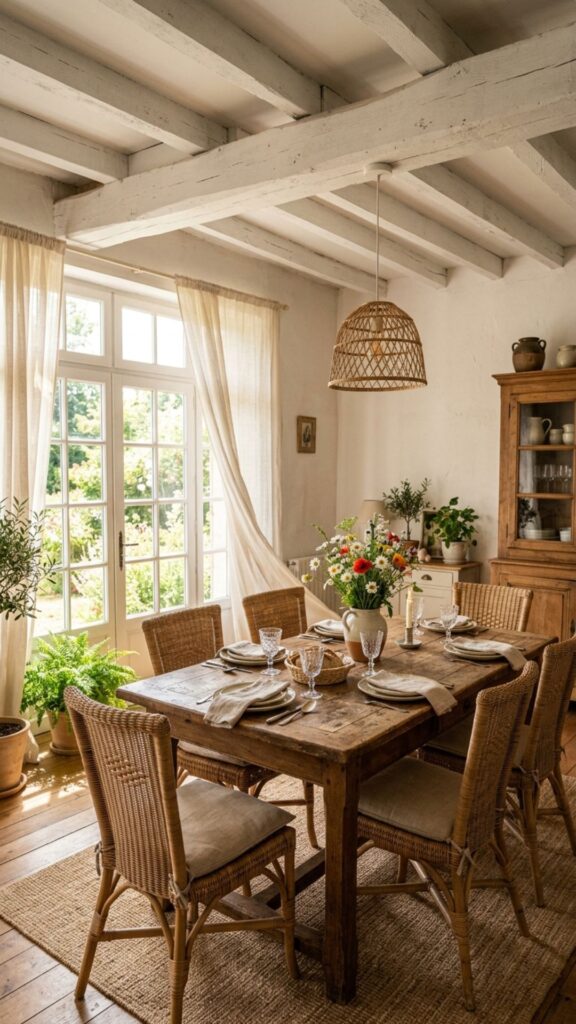
Whitewashing — applying a thin, diluted white paint over natural wood — softens the look of exposed beams while preserving their texture and grain. The result is a ceiling that feels rustic but also light and bright, which solves one of the most common problems with beam ceilings: they can darken a room significantly.
Mix one part white paint with one part water, then apply with a rag or brush and wipe back immediately. The more you wipe back, the more grain shows through. Whitewashed beams pair well with linen, rattan, and natural wood furniture in the dining room below — the palette reads as cohesive without being overly matched.
11. Geometric Painted Pattern
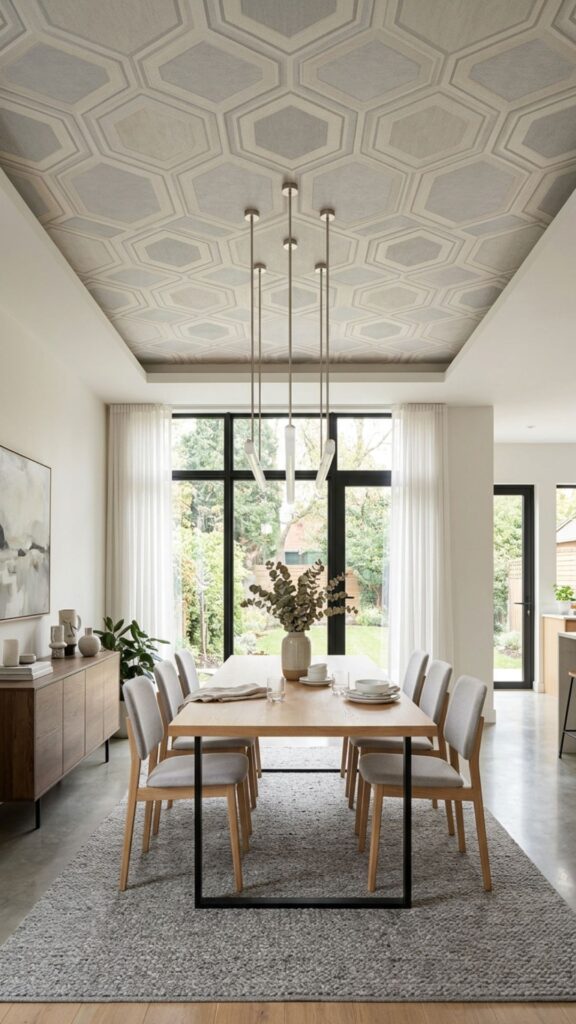
A hand-painted geometric pattern on the ceiling — chevrons, diamonds, or a simple grid — adds graphic energy without requiring any structural work. It’s one of the most budget-friendly dining room ceiling design options and one of the most personalizable.
Use painter’s tape to map out the pattern on the ceiling before you pick up a brush. Two or three colors in the same tonal family keep the result looking sophisticated; high-contrast combinations like black and white are bolder but equally effective in the right room. A geometric ceiling works best when the walls and furniture stay relatively simple.
12. Plaster Medallion Details
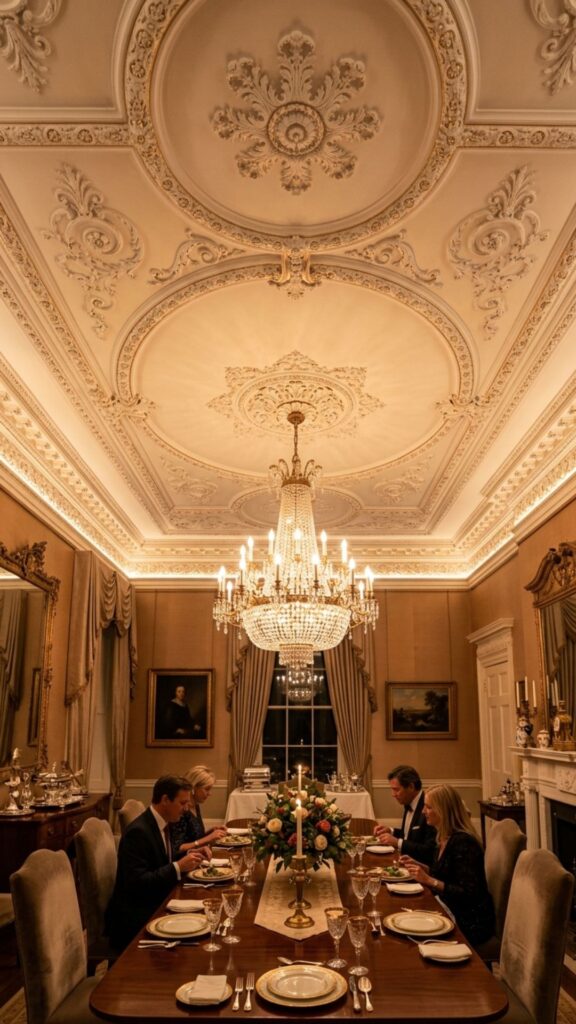
Beyond the standard circular medallion, decorative plaster details — rosettes, scrollwork, and panel molding applied directly to the ceiling — can create a custom, crafted look without a full renovation. Applied in a symmetrical arrangement around the light fixture, they suggest a period-appropriate formality.
These details are widely available as peel-and-stick or lightweight adhesive pieces, making them a genuinely DIY-friendly upgrade. Once primed and painted, they’re nearly indistinguishable from original plasterwork. This works best in traditional, classical, or transitional dining rooms where the formality of the detail matches the rest of the room.
13. Stretched Fabric Ceiling
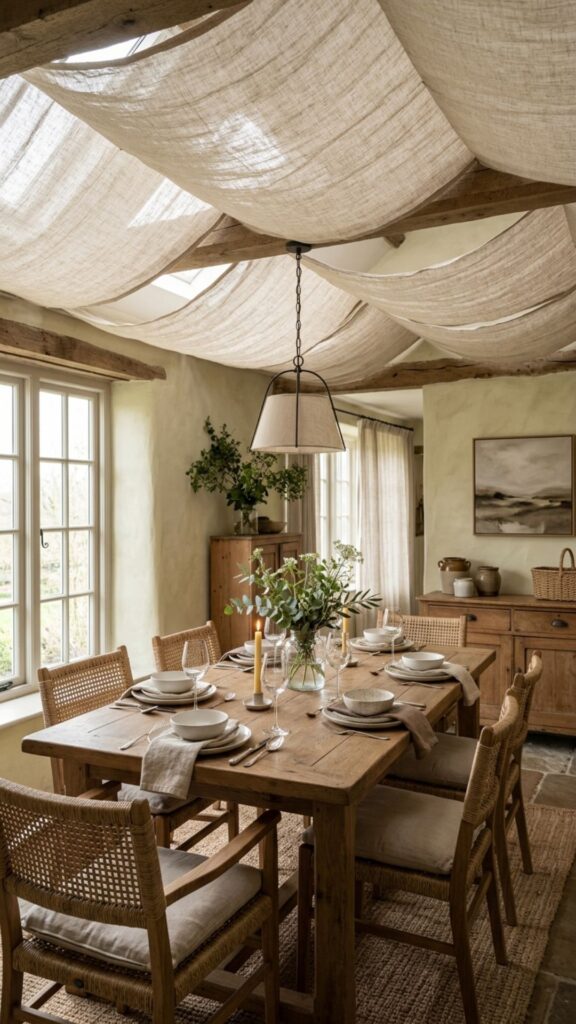
A fabric ceiling — typically stretched muslin or linen — softens acoustics, hides imperfections, and adds a warm, textured quality that’s genuinely hard to achieve with paint or drywall alone. It’s popular in more eclectic or bohemian dining room designs.
Install a simple batten frame around the ceiling perimeter, then stretch the fabric across and staple it behind the battens. The fabric should be taut but not pulled tight enough to distort. A sheer white or natural linen reads as elegant; a printed or embroidered fabric adds pattern. Either way, the texture it adds is unlike anything you can achieve with a standard finish.
14. Skylight or Solar Tube Addition
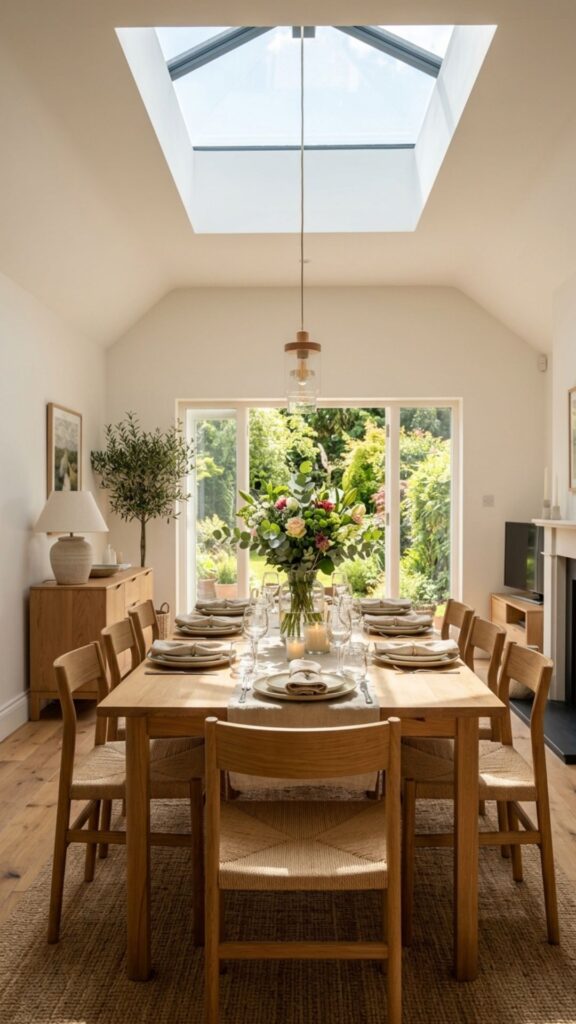
Natural light from above transforms a dining room ceiling from a flat surface into a dynamic architectural element. A skylight or solar tube brings daylight directly into the room, makes the ceiling the most interesting feature by default, and reduces the need for artificial lighting during the day.
Solar tubes are a less invasive option than skylights — they’re installed in a few hours with minimal structural work and bring in a surprising amount of light. They work best when positioned directly above the dining table. In rooms where a skylight isn’t possible, a sun tube is often a practical and affordable alternative.
15. Layered Pendant Cluster
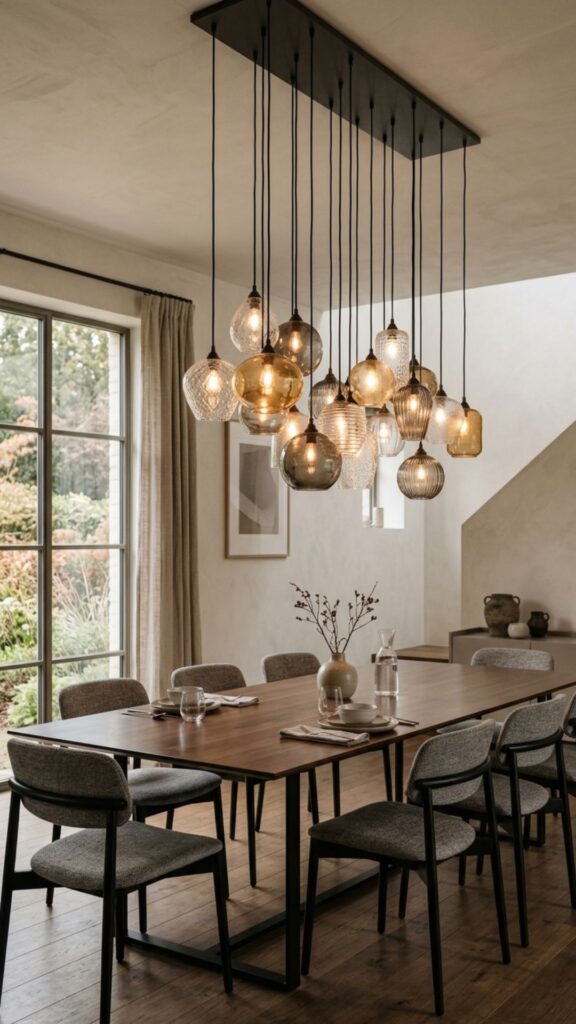
Instead of a single chandelier, clustering three to five pendant lights at varying heights creates a dynamic, sculptural ceiling feature. This dining room ceiling design approach works especially well in rooms where the ceiling itself is plain — the lights become the visual interest.
Keep all pendants in the same finish and material family for a cohesive look, but vary the cord lengths. The lowest pendant should hang roughly 30 to 34 inches above the tabletop. Use Edison bulbs or globe bulbs for warm, flattering light that suits a dining atmosphere.
16. Stenciled Ceiling Pattern
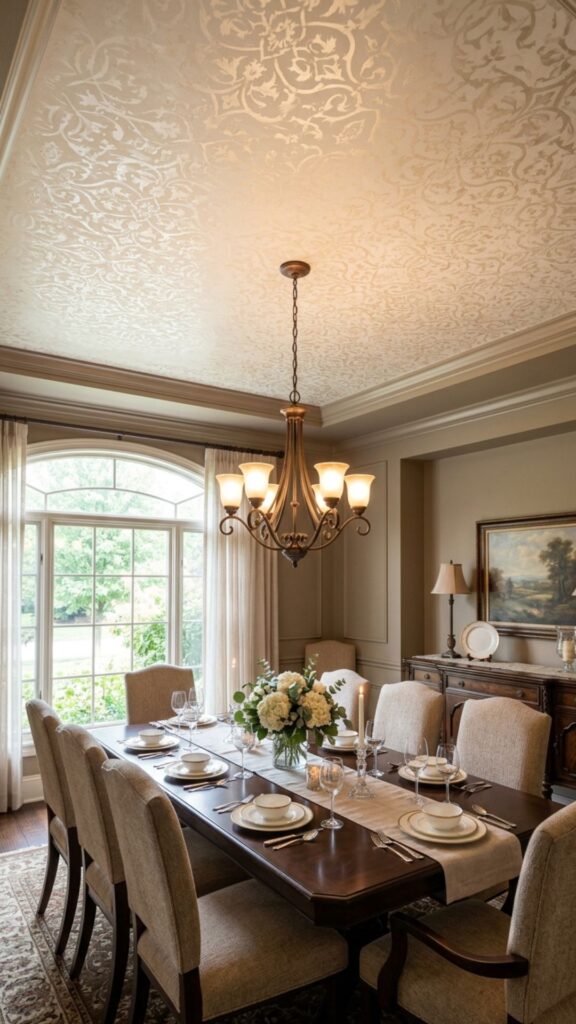
A stenciled ceiling achieves the look of wallpaper or painted detail at a fraction of the cost. Large-scale stencils — available from craft and paint suppliers — let you apply a repeating pattern with basic rolling technique, no artistic skill required.
Moroccan lattice, chinoiserie, and damask patterns are popular choices for dining rooms because they have enough density to read from below without looking too busy. Use a paint one shade lighter or darker than the ceiling base coat for a tone-on-tone effect, or contrast it more boldly if you want the pattern to dominate.
17. Cove Ceiling with Indirect Lighting
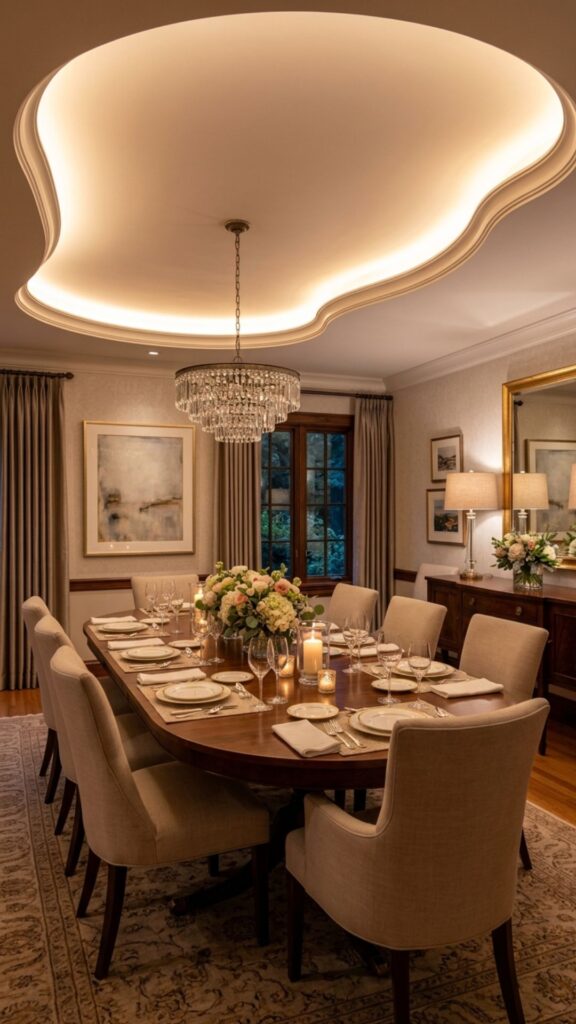
A cove ceiling features a curved or angled transition between the wall and ceiling — typically concave — that hides a light source inside it. The light bounces off the curve and floods the ceiling with an even, ambient glow that’s warm and diffused.
This is one of the most flattering dining room ceiling designs for evening use because it eliminates harsh shadows and fills the room with a soft, wrap-around light. LED strip lighting in warm white works best inside the cove. Pair it with a dimmer switch so you can adjust the intensity for different occasions.
18. Reclaimed Wood Plank Ceiling
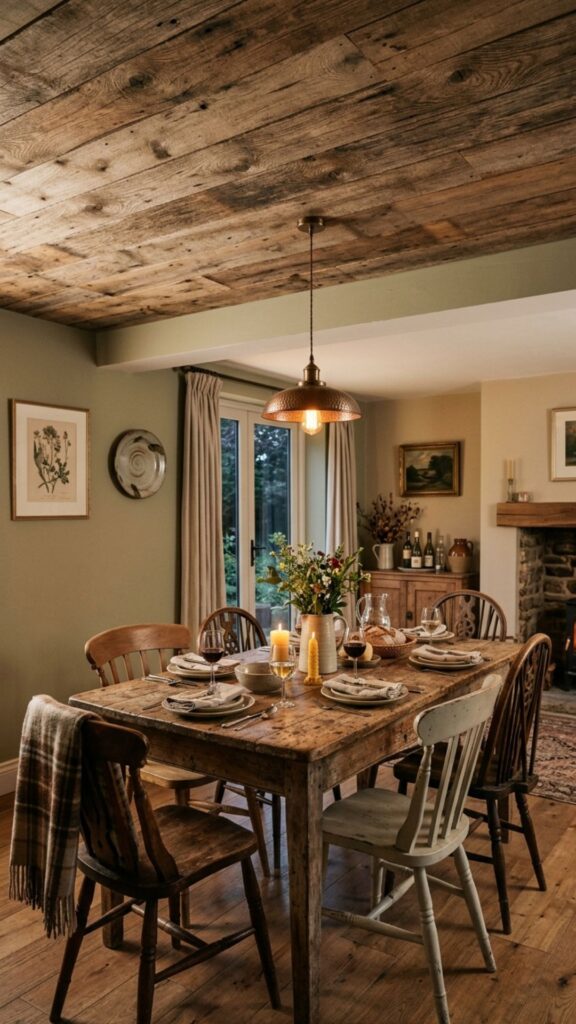
Reclaimed wood — salvaged from old barns, warehouses, or flooring — adds a history and texture to a dining room ceiling that new materials simply can’t replicate. The variation in grain, tone, and weathering makes each ceiling unique.
Source reclaimed planks from architectural salvage yards or online suppliers. They typically need to be kiln-dried before installation to prevent warping. Finish with a clear matte sealer to protect the surface without obscuring the natural character of the wood. This ceiling works especially well above a farm table or in a dining room with industrial or eclectic leanings.
19. Two-Color Ceiling Treatment
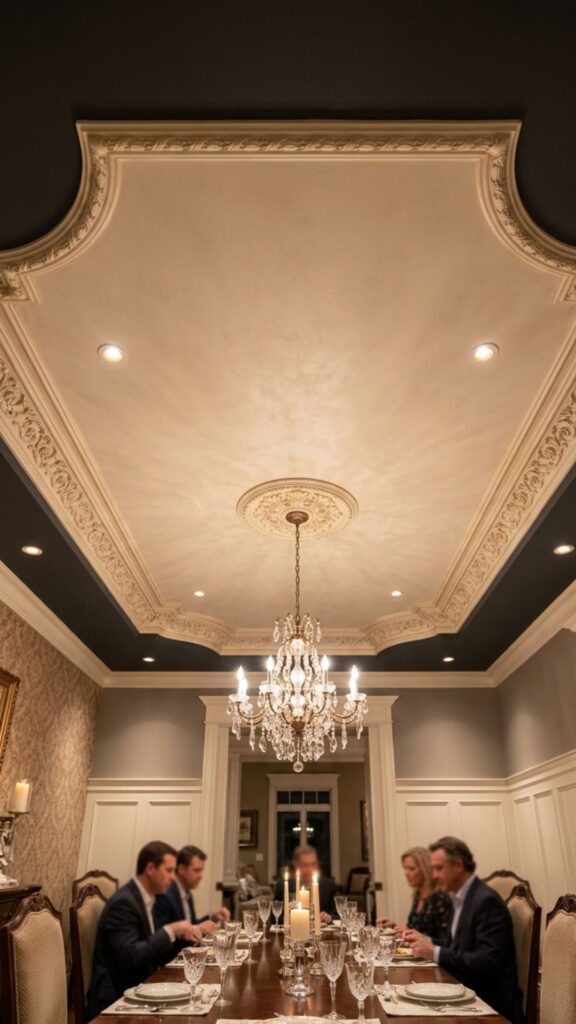
Dividing the ceiling into two tones — one for the main field and one for a border, molding detail, or coffered panel — creates visual structure without requiring any three-dimensional elements. It’s a paint-only solution that adds definition and depth.
A common approach is to paint the central ceiling area a soft color and the border between the crown molding and the field in a slightly deeper or contrasting tone. This makes the room feel taller at the edges and draws attention to the molding detail. The effect is subtle but noticeably more refined than a single flat color.
20. Woven Rattan or Bamboo Ceiling Panels
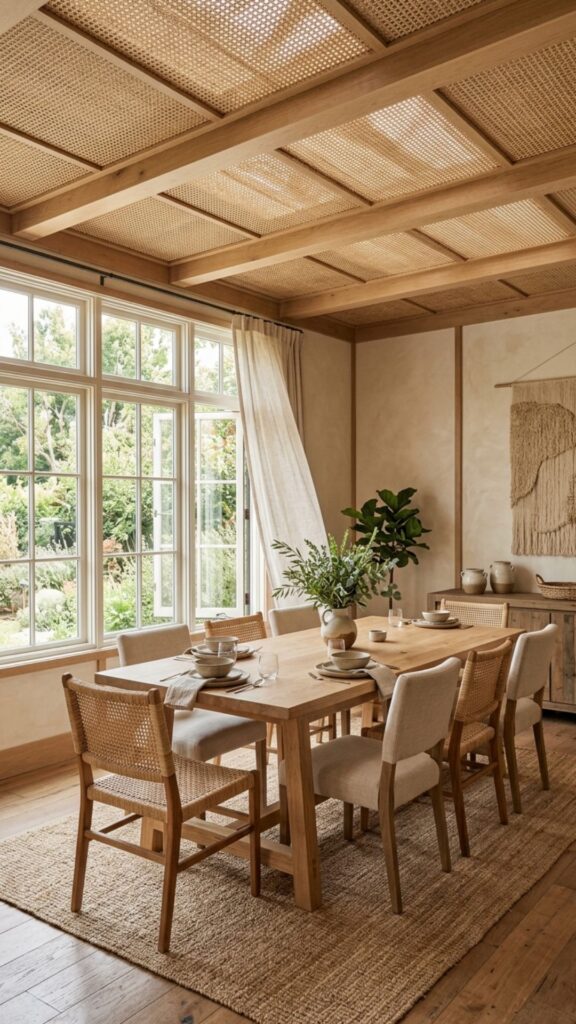
Woven natural fiber panels — rattan, bamboo, or seagrass — applied to the ceiling create a warm, textured surface that feels handcrafted and distinctly organic. In dining rooms with a coastal, boho, or tropical aesthetic, this dining room ceiling design treatment is immediately at home.
Panels come in sheet form and can be stapled or glued over an existing ceiling with minimal preparation. Frame them with simple wood trim for a more finished look. They work particularly well in covered outdoor dining spaces or sunrooms where the natural material suits the environment directly.
Conclusion
The ceiling is one of the most overlooked surfaces in any dining room — but as these 20 ideas show, it’s also one of the most powerful. Whether you go bold with a painted accent color, add structural character with exposed beams, or keep it simple with a statement medallion and chandelier, the right dining room ceiling design ties the whole room together in a way that furniture and wall treatments alone can’t.
Start by assessing your ceiling height, your existing style, and your budget. Then pick the idea that solves your biggest challenge — whether that’s adding warmth, improving lighting, or simply making the room feel more finished. Even one well-chosen ceiling treatment can completely change how you experience the space.
What is the best dining room ceiling design for low ceilings?
For low ceilings, avoid heavy structural details like deep coffers or thick beams. Instead, paint the ceiling the same color as the walls to blur the boundary and make the room feel taller. A simple cove light or a semi-flush pendant keeps lighting functional without dropping the ceiling height visually.
How do I choose a ceiling design that matches my dining room style?
Match the formality level of the ceiling to the rest of the room. Traditional dining rooms suit coffered ceilings, medallions, and plaster details. Casual or farmhouse spaces work well with shiplap, whitewashed beams, or tongue-and-groove planks. Modern rooms are best served by clean tray ceilings, geometric patterns, or pendant clusters.
What ceiling design makes a dining room look bigger?
A light-colored ceiling — especially one painted the same shade as or slightly lighter than the walls — makes a room feel larger. Adding vertical elements like a narrow tray ceiling or slender beams draws the eye upward and increases the perceived height. Avoid dark colors and low-hanging fixtures in small dining rooms.
How much does it cost to update a dining room ceiling?
Cost varies significantly depending on the treatment. Paint is the most affordable option, ranging from a few dollars to a couple hundred including supplies. Faux beams, medallions, and wallpaper are mid-range updates that typically cost $100 to $500 for materials. Built-in tray ceilings or skylights are structural projects that can run $1,000 to $5,000 or more depending on scope and labor.